In this blog I give way for an article written by a longtime friend from the States with wich I feel honoured to share the same passion about the Viking period and the artefacts of that time for almost two decades now, David Mullaly.
One of the most distinctive elements of the Norse world-view involved a belief in the power of destiny, which determined how their lives would unfold, and of course how and when they were fated to die. Embodying that sense of inevitability were the three Norse fates or Norns, These were the Norse goddesses of destiny, identified as three sisters named Urd, Verdandi, and Skuld. They lived underneath the world tree, where they wove the strands which make the tapestry of life.
There are historical precursors. Unlike the Norns, the Greek version of the Fates each had a particular function. Their names were Clotho (Spinner), Lachesis (Allotter), and Atropos (Inflexible). Clotho spun the “thread” of human fate, Lachesis dispensed it, and Atropos cut the thread. And the derivative Roman version was the Parcae. Presumably, these earlier trios had a direct influence on the Norse belief in the Norns.
Given the importance of the role of Fate and the Norns for the Nordic people, one would have expected that some sort of representation of them would have been found among the artifacts which have survived, and such would seem to be the case. However, the rarity of those is obvious. One very strange-looking trefoil brooch was found at Kvarberg Hill in central Norway, and is currently in the Museum of Cultural History of the University of Oslo.
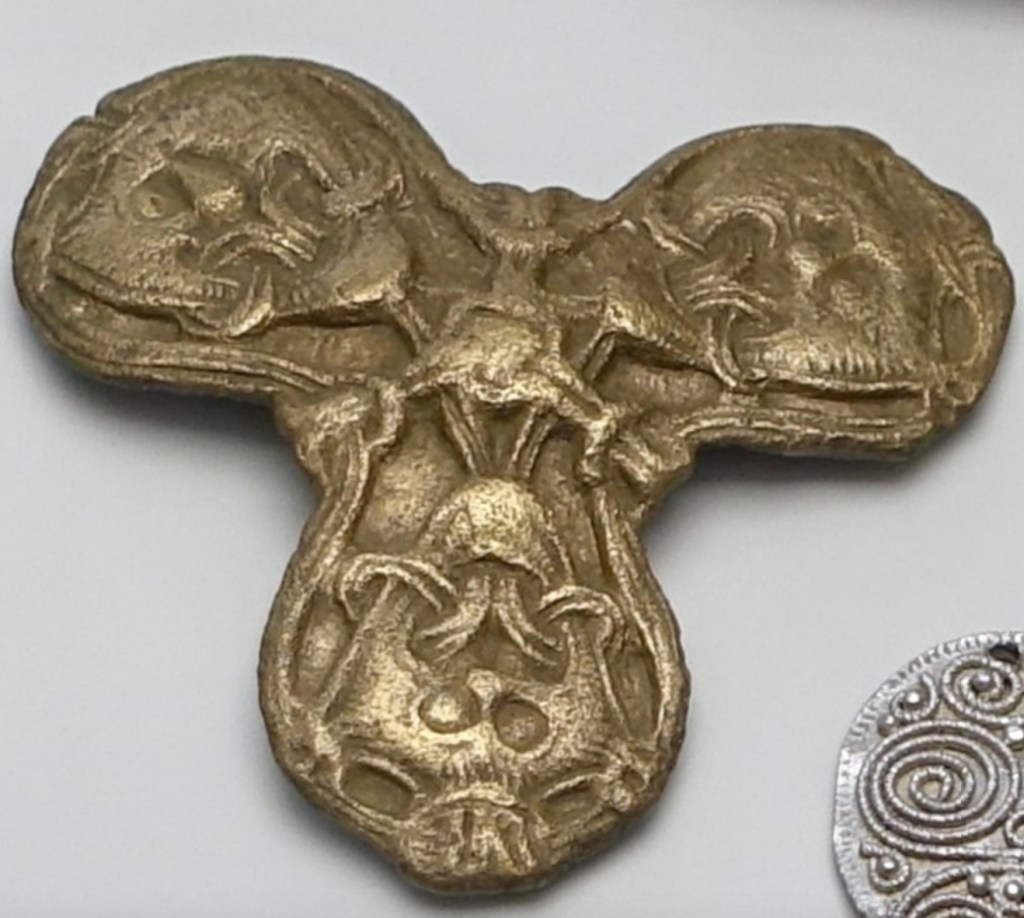
A fairly flat bronze three-lobed brooch, it features three large heads with double strands looping into the open mouths from the sides and then out from below the chins. Note that the strands connect to the other heads through a trefoil shape in the middle of the brooch. Although the faces are recognizable, their features are unrealistic, and are closer to cartoons than human heads.
The only commentary I’ve found for that Kvarberg trefoil is in Jan Petersen’s seminal work Viking Age Jewelry (Oslo, 1928) on p.108. There he says that it’s “highly peculiar,” and is a “genuine product of the Viking Age’s imagination.” He also notes that it was an isolated find (and so not reliably datable), but “is clearly characterized by the Borre style” of decoration. He says nothing about the possible subject of the decoration.
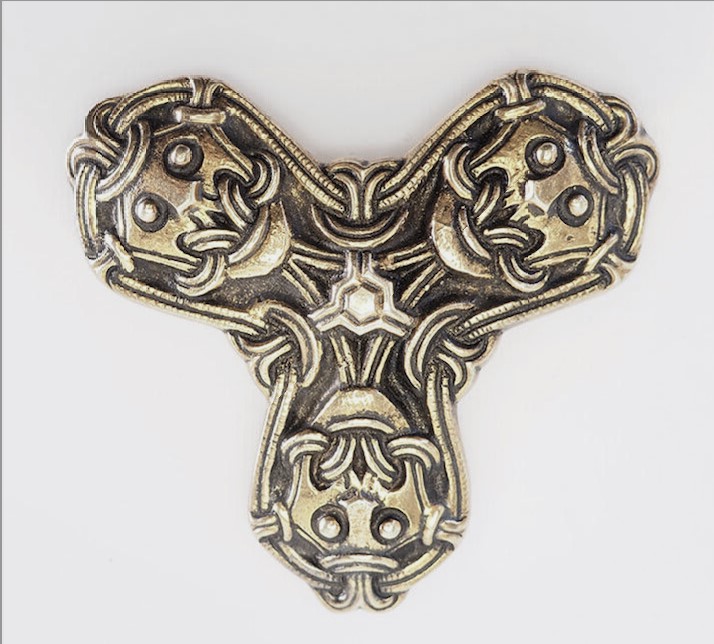
Modern jewelry designer David Andersen made many reproductions inspired by that find. Although the contours of the modern brooches are considerably deeper, the basic design is the same: three large heads with double strands looping into the open mouths from the sides and then out from below the chins. Although a large number of this type of reproduction have been sold on Ebay and elsewhere, no one has tried to analyze or even describe the distinctive image.
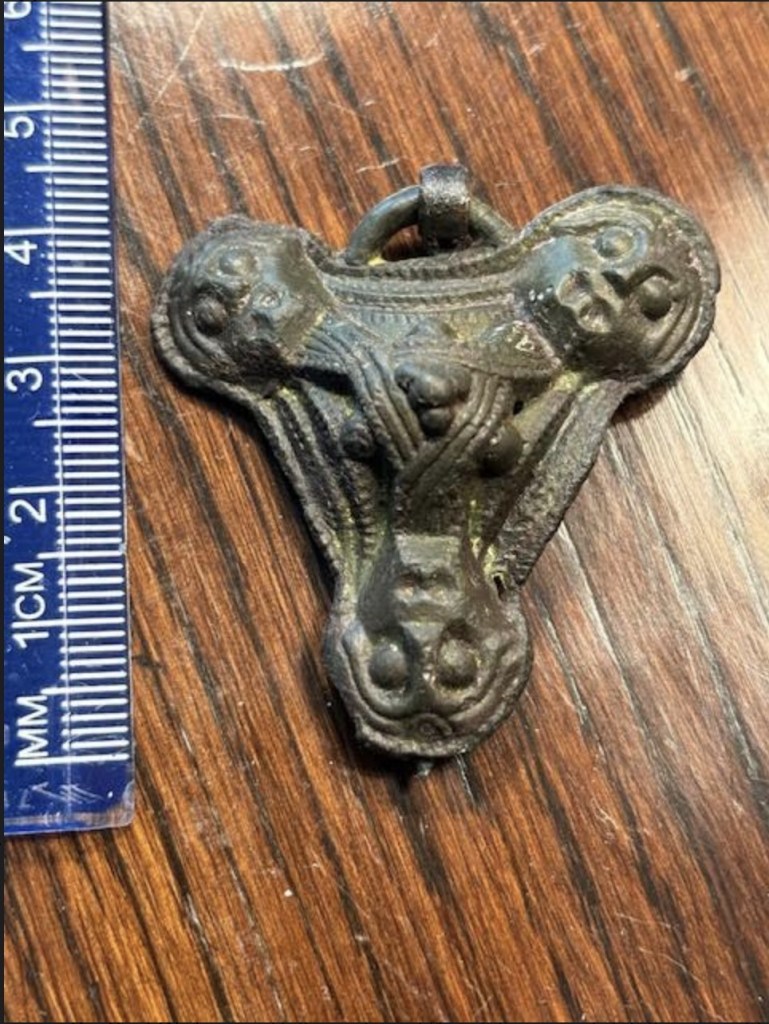
Another intriguing artifact has been found in the Rus Viking region, and therefore it probably originated in Viking Sweden—or was created far from home by a Swedish craftsman. Like the brooch found in Norway, it has a trefoil shape, but it includes a startling number of differences. First, the faces seem more realistic than the Norwegian find. Although the eyes are bulging, the visage is distinctively human-like, and may suggest an Oseberg style. The shape and details are all representational. The pair of triple cords or strands lead to the chin, rather than involving interlace around the face and under the chin.

The divided shape of the mouth suggests that the pair of triple cords are meant to be seen as emerging from the mouth—perhaps they are speaking the fates of men. There is also a roughly semi-circular emblem on the forehead of each face, which must have had some sort of symbolic significance. As the twin cords leave the face, they cross each other and join with the others to create an interlaced raised mound or boss in the middle with three small balls defining the central trefoil shape. All three faces are linked to each other by the interlaced strands.
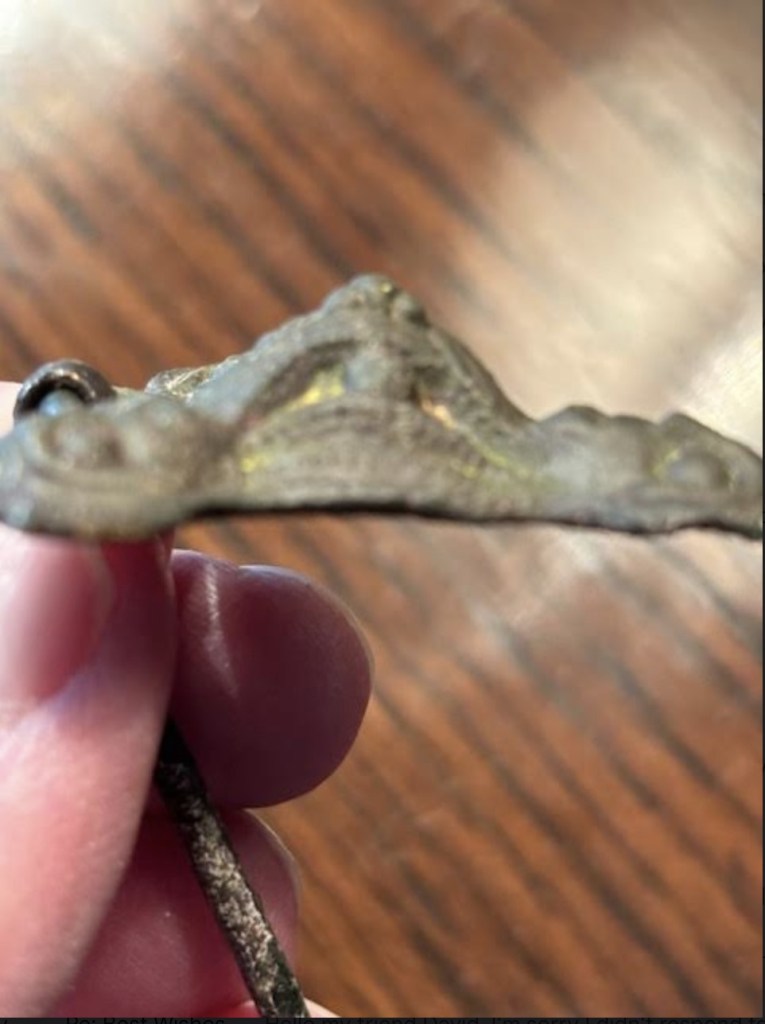
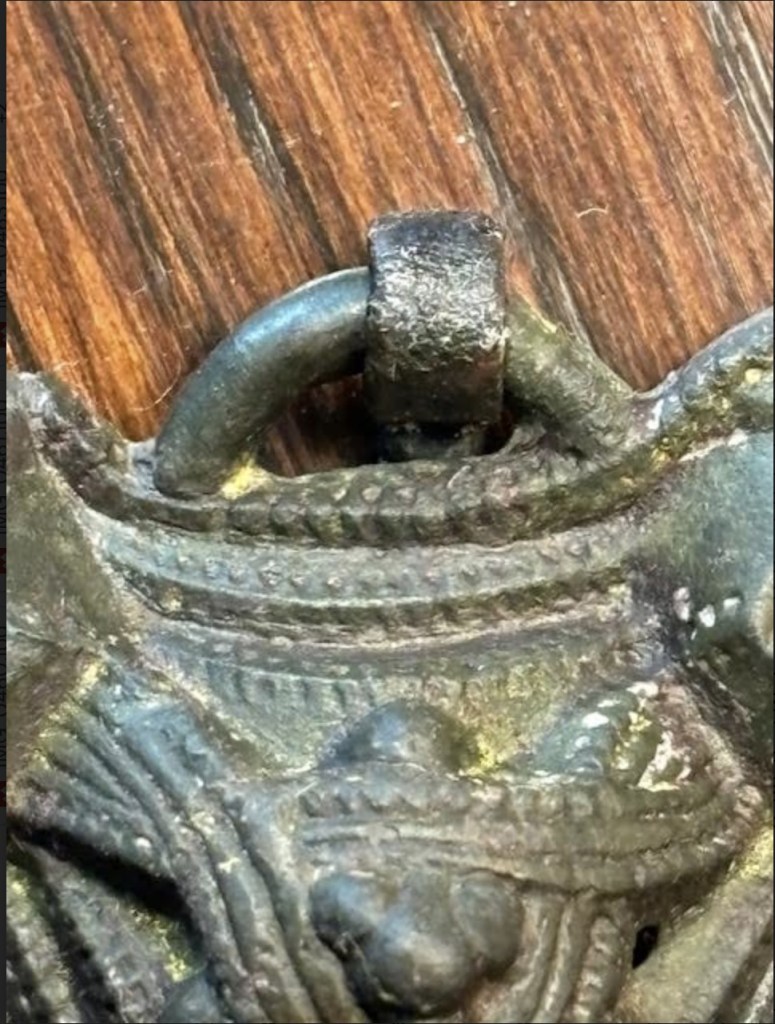
Unquestionably the most startling structural feature of the brooch is the pin assembly. Typically, trefoil brooches, and almost all types of Viking brooches, show at least traces of a pin pivot and a catchplate on the reverse. In this case, however, there is a single integral loop on the outside between two lobes, with a long pin and the slight remains of a catchplate on the back. Jan Petersen’s book has pictured thirty-one examples of trefoil brooches, and none of them have even a trace of that loop at the top between the two lobes. I’ve never seen that sort of pin assembly on any trefoil—or any other type of brooch.

There’s almost no possibility that this trefoil brooch was a one-off—a single item which was unique when it was made. Given the labor and expertise which would have been required to make the mold for the brooch, there surely would have been multiple examples made. The casting involved in the creation of this brooch is impressive. The texture covering almost every part of this piece of jewelry suggests great skill and an attention to detail.
Because of the Borre characteristics of the Kvarberg trefoil brooch, a tenth century dating for its making is reasonable. Given what must be described as a much more complex design of the Rus Viking example, an even earlier date is quite likely. One often sees types of artifacts being slowly degraded or attenuated over time in their decorative complexity, and the Kvarberg example seems to be a simpler version of the other one. Plus the distinctive and relatively primitive pin arrangement of the latter hints at an earlier time frame as well. This could be a 9th century item of jewelry.
Identifying the imagery of these two trefoil brooches as a representation of the Viking Norns is admittedly conjectural, but it seems as good of an interpretation as any. If only the Norse people had provided clearer cues or commentaries about some of the “highly peculiar” objects they created, our jobs as historians or analysts would be so much simpler. However, they were busy living their lives, and exploring the world that they knew. Ultimately, some of their artifacts, like these two trefoil brooches, simply whisper quietly to us, and we must listen carefully in order to try and decipher what they say.
 Thomas Kamphuis