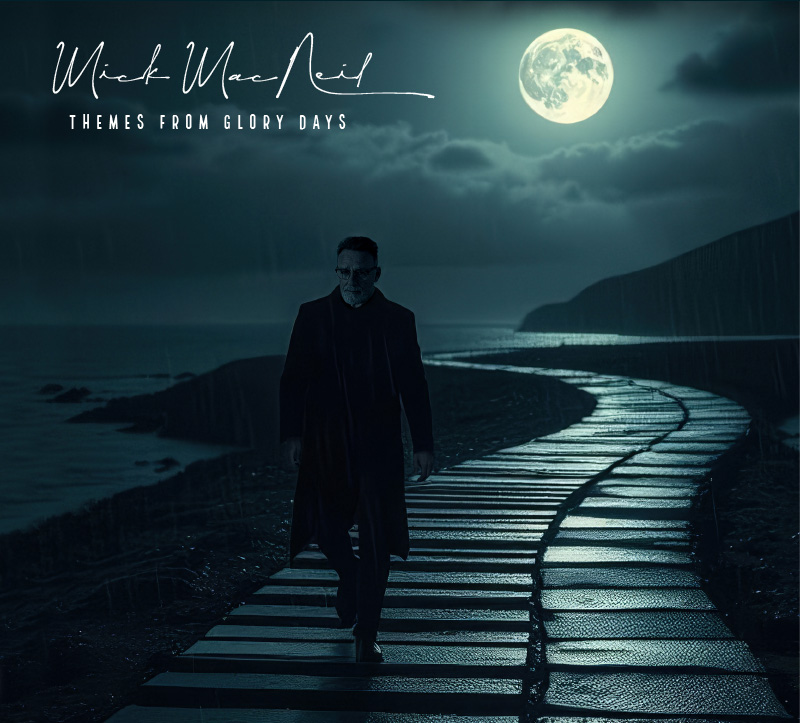
The long wait, which at one point seemed to stretch into a lifetime, has, unexpectedly, come to an end. This ‘prisoner’ is free and breathing in the air he has been deprived of for so long: Mick MacNeil has, after twenty-seven years, released new music. As he himself says:
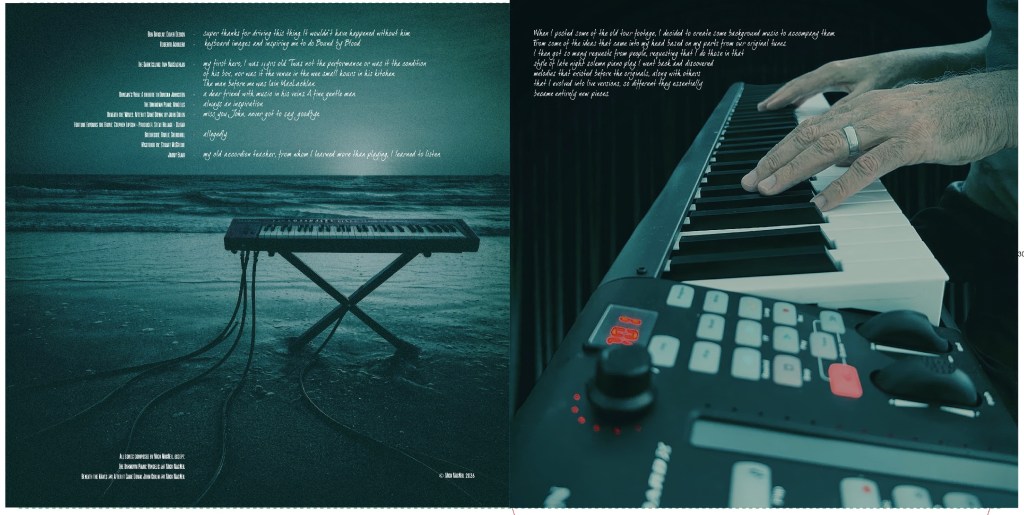
‘When I posted some of the old tour footage, I decided to create some background music to accompany them. From some of the ideas that came into my head based on my parts from original tunes, I then received so many requests from people asking me to do them in that style of late-night, solemn piano playing. I went back and discovered melodies that existed before the originals, along with others that I developed into live versions – so different that they essentially became entirely new pieces.’
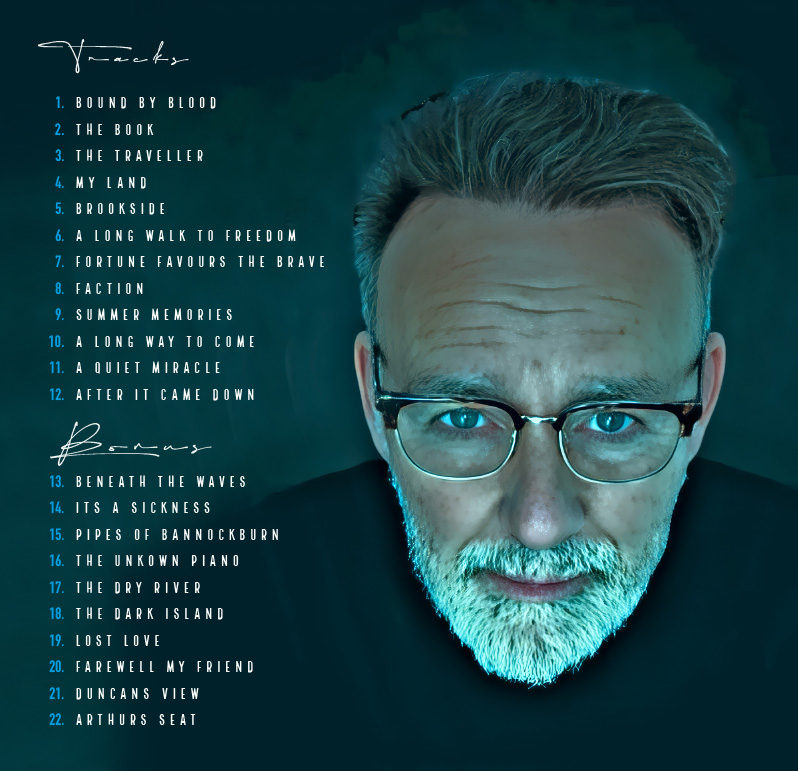
Themes from Glory Days – a beautiful album cover, by the way, as if he’s walking across the keys of a stone piano – is actually a double album, with the second part presented as bonus tracks. But is there really such a thing as bonus tracks when it comes to Mick MacNeil’s keyboard work?
Bound by blood is clearly based on Street Fighting Years (1989). It’s wonderful to hear the piano so isolated. Oh my, has it really been 37 years now? The book – naturally, The book of brilliant things – is reworked here into an almost classical version. The Traveller is based on I Travel (1980). For me, it’s one of the highlights on Themes from Glory Days.
My Land is a reworking of This Is Your Land (from Street Fighting Years, 1989, ed.) Just how influential was his sound on Street Fighting Years on the best tracks from that album, it showed where Simple Minds could have gone after Once Upon a Time (1985). Strangely enough, his spirit seems emphatically present on Real Life (1991), but I don’t know what Mick himself thinks about that? Themes from Glory Days is, unwittingly, also a reacquaintance with that album, Street Fighting Years. That’s no punishment. Brookside seems like a reworking of Scar? (1979) in a late-night version.
A Long Way to Freedom exudes the atmosphere of Mandela’s Day, but transforms into something so much deeper than that that, indeed, you can regard it as an entirely new song. The tone is majestic and soothing. I’ve discussed Fortunes Favour the Brave here before. Faction is a reworking of Factory (1979). Here, the track is transformed into an exciting 21st-century version. He really gets the most out of his keyboards. Summer Memories is a truly beautiful adaptation of Someone Somewhere in Summertime (1982).
A Long Way to Come has moments of a Talk Talk-like stillness. Particularly beautiful. A reworking of Come a Long Way (1985). Yet it has become a song entirely of its own. A quiet miracle is vintage Mick MacNeil. Three seconds in and you know what you’ve been missing from Simple Minds for thirty-six years. Jim Kerr once announced him – I was there – during a concert on 10 June 1986 in Het Amsterdamse Bos in Amsterdam as “The quiet man. The man in the sky.” For once, there wasn’t a word of a lie in that. A quiet miracle is exactly what it says: a quiet miracle that comes to us. Quietly hoped for. Never expected. After It Comes Down is a reworking of Let It All Come Down (1989). What a sound. I never heard it like this on the – then still – LP. This is an orchestra, bee: a cathedral being opened wide. You feel yourself rising to heaven – but let’s wait a little longer for that, Mick. In the meantime: goosebumps.
Beneath the Waves is magnificent. The depth of the melody, the depth of the sound and the orchestral arrangement once again bear witness to what was once the sound of Simple Minds. It’s a Sickness is a marvellous minute and a half of keyboards and – to me, unintelligible – background whispering. It has an alienating quality that works well. Pipes for Bannockburn – how Scottish do you want it to be? A new track and – once again – a testament to Mick MacNeil’s versatility as a bagpipe player. The track ends in a dreamy late-afternoon keyboard escapade. The Unknown Piano seems to be a new track as well.
The Dry River seems to me to be a new track as well. Might the reviewer still be allowed one wish? A few tracks in the style of – and, crucially, played on – the keyboards of that era, from the period 1979–1982? So not so much those specific tracks, but ‘the style of’? Or: ‘just’ new tracks but played across the full range he must have (or do those old synths no longer exist?) Or am I getting ahead of myself here, and is this something for a future project together with the other O.P’s – original players – originals Derek Forbes and Brian McGee?
The Dark Island strikes me as a new track. Once again, it proves that the piano is the foundation of music. Played on a small or grand scale, or both at once, may this orchestra continue for a long time to come. Lost Love is another new track – far too short – more of an atmospheric sketch than a conventional song with a clear beginning and end. Once again, a sense of calm emerges that is so pleasant to listen to. Farewell My Friend is another completely new track, an ode to a friend who passed away recently. Duncan’s View is, in my eyes, something entirely new. It exudes a serene calm. An atmosphere of: ‘Everything’s fine, don’t worry.’ It makes you feel, well, calm. Mick should play a prank on certain gentlemen – I shan’t name names – and suddenly turn up during the final soundcheck just before a concert starts and play this song. Guaranteed: the highlight of the evening. And I’d love to see the look on ‘those two’s’ faces.
Finally, on Arthur’s Seat, Mick showcases his unrivalled skill on the accordion.
Jokingly (?), Mick announced this album in light of the time ‘when I used to be somebody’. I hope it truly was meant in jest, but just in case, let me tell you this, Mick: you were, are and always will be not just ‘someone’, but, for countless people, visible and invisible, a giant who has travelled with them their whole lives and will only die with their last breath. We are all growing older, and the fact that in 2026 we are able to listen to new music from you, a distant echo from the past, a song that returns daily in which you played such a prominent (leading) role, gives us oxygen for the time we have left and provides an enormous boost to the feeling of being alive. What moved us is felt once more – like the scent of cherry blossom from my youth or the taste of a Madeleine cake from Marcel Proust’s In Search of Lost Time – as a bolt from the blue, different, yet more intense than before. That renewed encounter is a feeling of emotion that cannot be captured in words. Mick MacNeil has rediscovered time and shares it with us.
We hope – with agonising patience – for much more. From his hand and together with Derek Forbes and Brian McGee.
 Thomas Kamphuis
Je moet ingelogd zijn om een reactie te plaatsen.